Marble Roller Coaster Project: A Comprehensive Guide
Documenting your marble roller coaster project in a PDF report allows for detailed record-keeping, showcasing design choices, and presenting performance data effectively.
This comprehensive guide details construction, optimization, and troubleshooting, mirroring the insights found in online tutorials and experiments like those from MRLs Super Science.
Marble roller coasters represent a fantastic intersection of physics, engineering, and creative design, offering a hands-on learning experience.
These projects, often documented in a project PDF, challenge builders to apply principles of potential and kinetic energy, friction, and momentum.
The goal is to construct a track that allows a marble to navigate a complex path, often incorporating loops, curves, and lift mechanisms.
Resources like online tutorials and experiments, such as those featured in MRLs Super Science, provide inspiration and guidance for successful builds.
Project Goals & Objectives
The primary goal of this marble roller coaster project is to design and build a functional track that successfully transports a marble from start to finish.
A key objective is to minimize completion time, with a target of 15 seconds, as suggested in various educational contexts.
Documenting the entire process in a detailed PDF report is crucial, outlining design choices, materials used, and performance data.
Further objectives include exploring concepts of energy conservation and applying problem-solving skills, inspired by resources like MRLs Super Science experiments.
Materials Required for Construction
Essential materials for building a marble roller coaster include flexible track components – cardboard strips are a common starting point – and robust support structures, often constructed from recycled materials.
Utilizing salvaged printer parts, like gears and rubber belts, can facilitate lift mechanisms, enhancing the coaster’s functionality.
A detailed PDF project report should meticulously list all materials, including quantities and sources.
Tape, scissors, and potentially hot glue are necessary for assembly. Documenting these details ensures reproducibility and aids in cost estimation for future iterations.
Essential Building Materials
Core materials for a successful marble coaster include cardboard – for track sections – and materials for a stable base, like wood or sturdy foam board.
Tape is crucial for joining track segments, while recycled materials offer cost-effective support structures.
A comprehensive PDF report should detail the specific type and quantity of cardboard used, noting dimensions and thickness.
Include a materials list with sources, aiding replication. Documenting these essentials ensures a clear understanding of the build process and facilitates future modifications.
Tools for Cutting and Assembly
Essential tools encompass scissors or a craft knife for precise cardboard cutting, a ruler for accurate measurements, and tape for secure assembly.
Hot glue guns offer stronger bonds, but require adult supervision.
Your project PDF should meticulously list all tools utilized, including blade types and adhesive specifics.
Photographs demonstrating proper tool usage are invaluable. Documenting these details enhances reproducibility and safety, especially for educational purposes, mirroring guidance found in resources like MRLs Super Science.
Designing Your Marble Roller Coaster
Initial designs should be sketched, detailing track layout, loop placements, and lift mechanisms. A well-documented project PDF must include these preliminary sketches, alongside explanations of design choices.
Consider incorporating multiple tracks or switches, as suggested by advanced builders.
The PDF should also outline the objective – minimizing completion time (e.g., 15 seconds) – and how the design addresses this goal. Referencing online tutorials and experiments, like those from MRLs Super Science, within the PDF adds value.
Basic Track Design Principles
Fundamental to a successful marble coaster is understanding potential energy conversion. Your project PDF should detail how height influences speed. Track sections must mirror each other in measurements, ensuring consistent marble flow.
Loops require precise construction – dividing sections into 0.5-inch partitions aids stability. The PDF should include diagrams illustrating these principles. Documenting the rationale behind track angles and curves demonstrates a grasp of physics, enhancing the project’s educational value.
Incorporating Loops and Curves
Your project PDF must meticulously document loop construction. Achieving a perfect loop involves dividing upper and lower sections into 0.5-inch partitions, secured with tape for adjustability.
Curves demand smooth transitions to minimize friction and maintain momentum. Include detailed sketches in the PDF illustrating curve radii and entry/exit angles. Explain how these elements impact marble speed and overall track performance, demonstrating a thorough understanding of design principles.
Construction Phase: Step-by-Step Guide
Your project PDF should begin with a detailed materials list and a sequential build process. Document each stage – support structure assembly, track section creation – with clear photographs.
Include precise measurements and assembly techniques. Explain how found materials were adapted for use. The PDF must illustrate the iterative process, noting adjustments made during construction. This detailed record will demonstrate a methodical approach to building a functional marble roller coaster.
Building the Support Structure
Within your project PDF, dedicate a section to the support structure’s construction. Detail the materials used – cardboard, foam board, or repurposed items – and their arrangement.
Include diagrams illustrating the base’s stability and the vertical supports’ placement. Explain how you ensured the structure could withstand the marble’s weight and momentum. Document any reinforcement techniques employed, and clearly show how the track sections attach to the supports.
Creating the Track Sections
Your project PDF should meticulously document track section creation. Detail the material – typically cardboard strips – and the process of forming curves and straightaways.
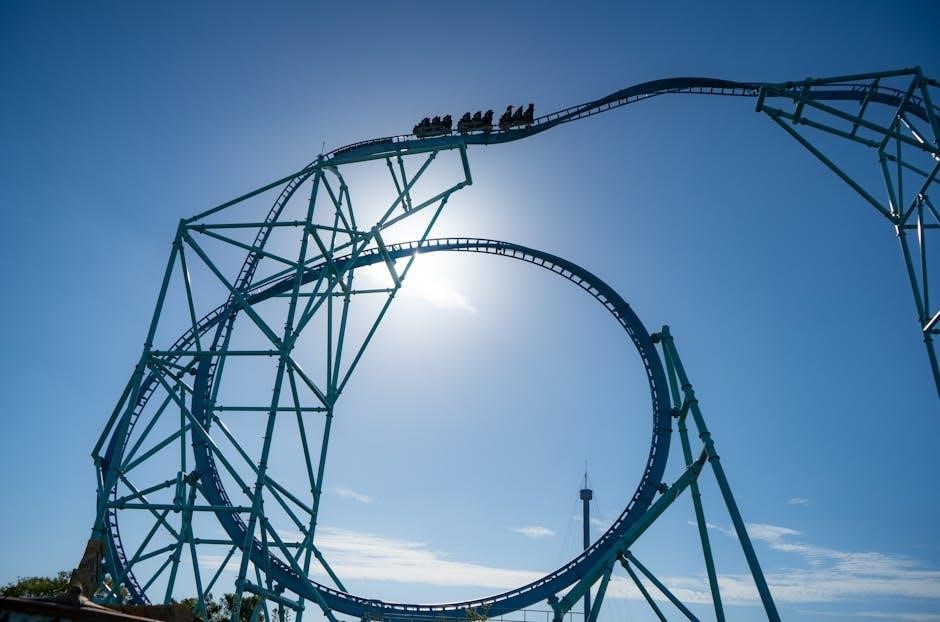
Include precise measurements, emphasizing the 0.5-inch partitions for loops, as suggested by user instructions. Illustrate how flaps are attached with tape, allowing for height adjustments. Diagrams showing cross-sections of the track are crucial. Note any techniques used to minimize friction and ensure a smooth marble path.
Lift Mechanisms: Getting the Marble to the Top
The project PDF must thoroughly explain the chosen lift mechanism. Detail whether a manual system or a gear-based approach (utilizing printer parts) was implemented.
Include diagrams illustrating the lift’s construction and operation. If using printer gears and a rubber belt, document the assembly process and how it regulates lift speed. Explain how the lift interacts with the track, ensuring a consistent marble release point. Performance data, like lift time, should be included.
Manual Lift Systems
The project PDF should detail the manual lift’s construction, including materials used and step-by-step assembly instructions. Diagrams are crucial, illustrating the lifting mechanism’s design and how the marble is transported to the track’s starting point.
Document the method for consistently releasing the marble, ensuring repeatable testing. Include observations on the lift’s efficiency and any challenges encountered during its operation. A clear description allows for replication and understanding of this simple, yet effective, approach.
Gear-Based Lift Systems (Utilizing Printer Parts)
The project PDF must thoroughly document the gear-based lift, detailing salvaged printer parts – gears and rubber belts – and their integration. Include a schematic illustrating gear ratios and how they affect lift speed.
Explain the assembly process, emphasizing precise alignment for smooth operation. Note any modifications needed for optimal performance. Document observations on lift consistency and the impact of gear ratios on marble delivery, referencing the slowed lift achieved by the user Covo.
Optimizing for Speed and Duration
The project PDF should dedicate a section to optimization strategies, detailing methods for maximizing speed while maintaining a reasonable run duration.
Document experiments focused on minimizing friction along the track and achieving optimal track angles, referencing the objective of a minimum completion time (15 seconds). Include data tables showcasing the impact of adjustments on marble velocity and overall run time, demonstrating a scientific approach to design refinement.
Minimizing Friction
The project PDF must include a detailed analysis of friction reduction techniques employed during construction.
Document material choices – smoother surfaces inherently reduce friction. Detail track alignment precision; misalignments create unnecessary resistance. Include photographic evidence of smoothing techniques applied to track sections. Quantify friction’s impact through timed runs, comparing performance with and without specific friction-reducing modifications, showcasing data within the report.
Achieving Optimal Track Angle
Your project PDF should meticulously document the rationale behind chosen track angles.
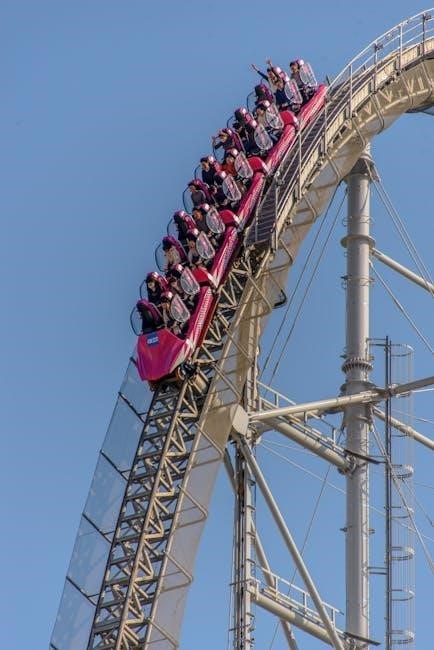
Include diagrams illustrating angle measurements at key points – initial descent, loops, and curves. Explain how steeper initial angles translate to greater speed, while gentler slopes maintain momentum. Detail any calculations used to determine optimal angles for loop-the-loops, ensuring marble completion. Present data from testing, correlating angle adjustments with marble performance, within the final report.
Testing and Refinement
The project PDF must dedicate a section to rigorous testing procedures and iterative refinement.
Detail initial testing, noting any failures – marbles falling off track, insufficient speed, or structural weaknesses. Document each adjustment made (angle changes, support reinforcement) and its impact on performance. Include time trial data, aiming for a target completion time (like 15 seconds). Analyze troubleshooting steps taken to resolve common issues, presenting a clear narrative of the design’s evolution.
Initial Testing Procedures
Your project PDF should meticulously outline the first series of tests. Begin by manually releasing the marble from the lift, observing its complete run.
Record whether the marble completes the track, noting any points of derailment. Document the initial run time. Repeat this process multiple times to establish a baseline. The PDF should include photos or videos of these initial runs, highlighting areas needing improvement. This data forms the foundation for subsequent refinements.
Troubleshooting Common Issues
The project PDF must dedicate a section to common problems and their solutions. Detail issues like derailments, slow speeds, or stalled marbles.
Include photographic evidence of the problem areas. Explain how adjusting track angles, minimizing friction, or reinforcing support structures resolved these issues. Document any loop adjustments, referencing the 0.5-inch partition technique. This section should serve as a practical guide for future builders facing similar challenges.
Advanced Design Elements
The project PDF should showcase advanced features beyond basic track layouts. Detail the integration of multiple tracks running in parallel, enhancing complexity and visual appeal.
Illustrate the implementation of switches and diverters, allowing the marble to choose different paths. Include diagrams and explanations of the mechanisms used. Reference any gear-based lift systems utilizing printer parts, and explain how these elements contribute to a more dynamic and engaging roller coaster experience.
Adding Multiple Tracks
Your project PDF should visually document the addition of parallel tracks, detailing their construction and interaction. Include schematics illustrating how multiple tracks diverge and converge, creating a more complex system.
Explain the challenges of maintaining consistent marble speed across multiple tracks and the solutions implemented. Showcase any unique design elements that enhance the visual appeal and functionality of the multi-track setup, referencing the overall objective of minimizing completion time.
Incorporating Switches and Diverters
The project PDF must clearly illustrate the design and functionality of any switches or diverters used to alter the marble’s path. Include detailed diagrams showing the mechanism’s construction, materials used, and how it integrates with the existing track layout.
Explain the logic behind the switch placement and how it impacts the overall coaster experience. Document any challenges encountered during implementation and the solutions devised, referencing the goal of achieving a minimum completion time.
Safety Considerations
The project PDF should dedicate a section to comprehensive safety protocols, emphasizing secure construction techniques to prevent collapses or dislodged components.
Detail measures taken to avoid sharp edges and potential hazards, ensuring a safe testing environment. Include photographic evidence of secure joints and stable support structures. A risk assessment outlining potential dangers and mitigation strategies is crucial, demonstrating responsible engineering practices throughout the build process.
Secure Construction Techniques
The project PDF must thoroughly document all fastening methods, detailing how track sections and support structures are joined for maximum stability.
Illustrate techniques like robust taping, gluing, or interlocking designs, emphasizing the importance of preventing movement during operation. Include close-up photos showcasing secure connections. A section on reinforcing weak points, particularly loops and curves, is vital for a safe and reliable coaster.
Avoiding Sharp Edges and Hazards
Your project PDF should dedicate a section to safety, specifically addressing potential hazards.
Detail how all sharp edges from cut materials (cardboard, plastic) were smoothed or covered to prevent injury. Include images demonstrating protective measures. Emphasize the importance of a stable base to prevent tipping. The report must clearly state any precautions taken to ensure a safe operating environment for both builders and observers.
Project Variations and Challenges
The project PDF should outline explored design variations, detailing attempts at simple versus complex coaster builds.
Document challenges encountered – like loop stability or lift mechanism failures – and the solutions implemented. Include sketches or photos of alternative track layouts. Discuss the impact of material choices on performance. A section dedicated to these explorations demonstrates a deeper understanding of the engineering principles involved, beyond basic track construction.
Simple Track Designs for Beginners
The project PDF should feature basic track designs, ideal for newcomers, utilizing readily available materials.
Include clear diagrams illustrating straight sections, gentle curves, and minimal elevation changes. Detail the construction process with step-by-step instructions and photos. Emphasize secure attachment methods using tape, focusing on stability. This section serves as a foundational learning experience, building confidence before tackling more complex elements, as suggested for initial builds.
Complex Coaster Designs for Advanced Builders
The project PDF should showcase advanced designs, including multiple tracks, loops, and diverters, for experienced builders.
Detailed schematics are crucial, illustrating precise measurements and angles for optimal performance. Include sections on gear-based lift systems utilizing printer parts, slowing the lift to a controlled speed. Explain switch mechanisms for track selection, enhancing complexity. The PDF should emphasize troubleshooting common issues encountered in these intricate builds.
Measuring Performance: Time Trials
The project PDF must detail time trial procedures, outlining how to accurately measure marble completion times.
Establish a target completion time – for example, 15 seconds – and document multiple trial runs. Include data tables within the PDF to record each run’s time, noting any observed inconsistencies. Analyze results to identify areas for optimization, referencing design adjustments. The PDF should clearly present the methodology for performance evaluation.
Setting a Target Completion Time (e.g., 15 seconds)
The project PDF should justify the chosen target time, like 15 seconds, explaining its relevance to the coaster’s design complexity.
Document the rationale behind this benchmark, considering track length, loop inclusion, and lift mechanism efficiency. Include a section detailing how exceeding or falling short of the target informs design modifications. The PDF must clearly state the target time and its significance within the overall project goals and performance evaluation.
Resources and Further Learning
The project PDF should include a curated list of resources utilized during development, such as online tutorials and guides for marble coaster construction.
Specifically, cite inspiration from science experiment sources like MRLs Super Science videos, detailing how those concepts were applied. Include links to relevant websites and documentation. A comprehensive bibliography demonstrates thorough research and provides avenues for continued learning and project expansion beyond the initial build.
Online Tutorials and Guides
Your project PDF should catalog helpful online resources discovered during the build process.
Include direct links to tutorials demonstrating track design, lift mechanisms, and optimization techniques. Document any specific guides followed for creating loops or curves, referencing user-shared instructions like those from “Covo”. A well-organized list allows for easy replication and provides a foundation for future iterations or more complex designs.
Science Experiment Inspiration (MRLs Super Science)
Your project PDF should detail how MRLs Super Science videos informed your design choices.
Specifically, document how Ms. Stephani’s experiments with marbles influenced your understanding of physics principles – momentum, gravity, and friction. Include screenshots or links to relevant videos. Explain how these concepts were applied to optimize track angles and minimize energy loss, ultimately impacting the marble’s speed and overall run time.
Troubleshooting: Common Problems and Solutions
Your project PDF must dedicate a section to troubleshooting.
Detail common issues encountered during construction and testing – track derailments, insufficient speed, or lift mechanism failures. For each problem, document the cause, the solution implemented, and the results. Include photos illustrating the issue and the fix. This section demonstrates problem-solving skills and iterative design, crucial for any engineering project, and showcases learning from challenges.
Cost Estimation and Budgeting
Your project PDF should include a detailed cost breakdown.
List all materials used – cardboard, tape, printer gears, rubber bands – and their associated costs. Differentiate between pre-existing materials (free) and purchased items. Create a budget table outlining estimated versus actual expenses. This demonstrates financial planning and resource management skills. Include potential cost-saving measures explored during the project, highlighting efficient material usage and resourceful problem-solving.
Project Documentation: Creating a PDF Report
A comprehensive PDF report is crucial for showcasing your marble roller coaster project.
Include a title page, introduction outlining project goals, detailed construction steps with images, a materials list, and cost analysis. Document design choices, lift mechanism specifics, and optimization strategies. Present testing results, including time trials (aiming for 15 seconds!), and troubleshooting notes. Reference resources like MRLs Super Science for inspiration and demonstrate a thorough understanding of the engineering process.

The Thrill of Marble Roller Coaster Engineering
Completing this marble roller coaster project offers a thrilling introduction to engineering principles.
From design and construction to optimization and documentation – including a detailed PDF report – you’ve experienced the iterative process of problem-solving. Resources like online tutorials and MRLs Super Science experiments provided valuable insights. Successfully navigating challenges and achieving a target completion time (e.g., 15 seconds) demonstrates a practical understanding of physics and engineering concepts.